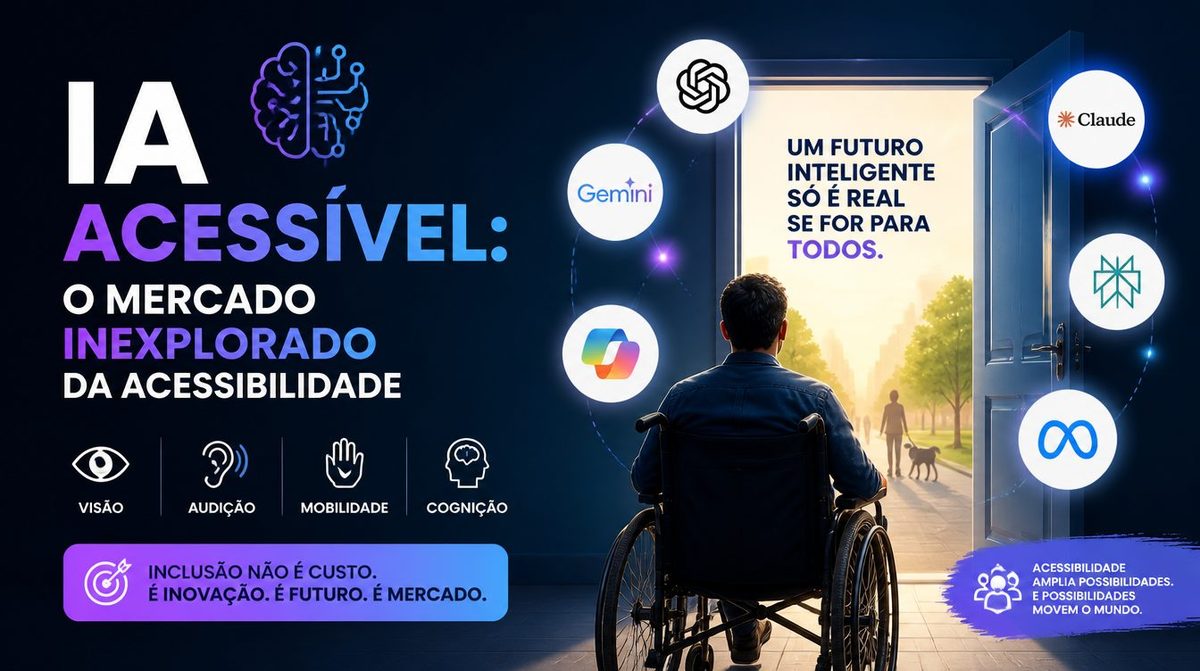
AI-powered digital accessibility is a real, largely untapped market: more than 1 billion people live with some form of disability, according to the World Health Organization, and AI has driven down the cost of serving them. What used to be a social gesture has become a strategic business decision.
Why is "accessibility is charity" an outdated idea?
That idea comes from a time when making a product accessible required expensive, custom-built adaptations, almost always added after the main product was already finished. It was treated as an extra cost, not as revenue.
With AI, this logic flips. Models for generating alt text for images, automatic audio transcription, avatar-based sign language translation, and real-time captioning have gone from multi-month projects to configurable features. The marginal cost of including more people has dropped. When the cost drops, what used to be a "social gesture" becomes a business decision.
How big is this market, really?
According to the World Health Organization, more than 1 billion people live with some type of disability — hearing, vision, mobility, or cognitive. That entire population is also made up of consumers: they browse websites too, and they make purchasing decisions too. Add to that older adults, who face growing sensory limitations with age, and families who choose brands with a specific member's inclusion in mind.
This isn't a small, symbolic niche. It's a market segment that most competitors in any sector still ignore — which, from a strategic standpoint, is pure opportunity: less competition, real demand, and a window to become the reference before the entire market catches on.
How does AI make accessibility economically viable?
In the past, offering service in sign language required hiring full-time human interpreters. Today, there are AI solutions that provide real-time translation through a 3D avatar, integrated into websites and apps, with a predictable subscription cost.
In the past, captioning videos was slow manual work. Today, automatic transcription tools deliver reasonably accurate captions in minutes, requiring only light human review.
In the past, adapting an e-commerce site for people using screen readers meant redoing development work. Today, there are plugins and AI layers that analyze a page's structure and fix accessibility issues semi-automatically, following the WCAG (Web Content Accessibility Guidelines), published by the W3C.
This shift doesn't eliminate the need for human judgment — AI models still make mistakes and require oversight — but it drastically lowers the barrier to entry for companies that used to say "we don't have the budget for that."
What are the risks of blindly trusting AI for accessibility?
Automating accessibility without validation is a real risk. An incorrectly generated caption, a nonsensical image description, or an overly literal sign-language translation can create more confusion than help — and, in some cases, public embarrassment for the brand.
The advisable path is clear:
- Use AI to generate the first version of accessible content.
- Put a human review process in place, especially for high-traffic content or content with high reputational risk.
- Listen to real users with disabilities before declaring "mission accomplished" — they catch issues no automated test can.
- Treat accessibility as an ongoing process, not a project with a delivery date.
Is this only for large companies, or can smaller businesses compete here too?
Smaller businesses actually have a speed advantage. A small company can review its website, add alt text with the help of generative AI, and test keyboard navigation in a few weeks — no committee, no internal bureaucracy, no multi-layered approvals.
Large companies generally have more resources, but also more structural slowness when it comes to changing legacy processes. This creates a real window for smaller businesses to position themselves as more inclusive and win over loyal customers who genuinely feel like they've been thought of.
How do you turn this into a competitive advantage, not just a one-off initiative?
Accessibility treated as an isolated marketing move has a short shelf life. The market catches on quickly to what's just talk and what's real practice.
The difference lies in building accessibility into the product from the design stage, not as a layer added afterward. That means:
- Include accessibility criteria in the brief for any new product or feature, from the start.
- Measure accessibility using the same quality indicators used for performance or security.
- Communicate real progress, without exaggeration, and acknowledge what still needs improvement.
This kind of consistency is what separates companies that are tapping into a real market from those that just use the topic for a seasonal campaign.
The next step is a decision, not an intention
Understanding that an untapped market exists doesn't change anything by itself. The decision that separates those who profit from this from those who merely agree with it in theory is simple: someone needs to audit what exists today, prioritize what hurts customers most, and use AI to solve it at a speed that used to be impossible.
Companies that treat this as a growth strategy, not as charity, will serve a larger, more loyal, and less contested audience than the market average.
Discover where your business is losing customers due to lack of accessibility
Let's map the real friction points in your digital journey and show you where AI can solve them quickly and affordably.
Let's talk →Frequently asked questions
Is accessible AI the same thing as assistive technology?
Not exactly. Assistive technology is any tool built to help people with disabilities, like screen readers. Accessible AI is the use of artificial intelligence to make digital products, services, and environments usable by more people, often automatically and built in, without needing a separate device.
Is investing in AI-powered accessibility expensive for a small business?
It depends on where you're starting from. Many accessibility features today already come built into generative AI tools and development platforms, at low marginal cost. The bigger investment tends to be time and priority, not necessarily heavy capital in proprietary technology.
How does a company start applying AI for accessibility without knowing where to begin?
The first step is to audit the current customer journey using accessibility testing tools and listen to real users with disabilities. From there, prioritize one friction point at a time, measure the impact, and use AI to automate the solution that already works manually.