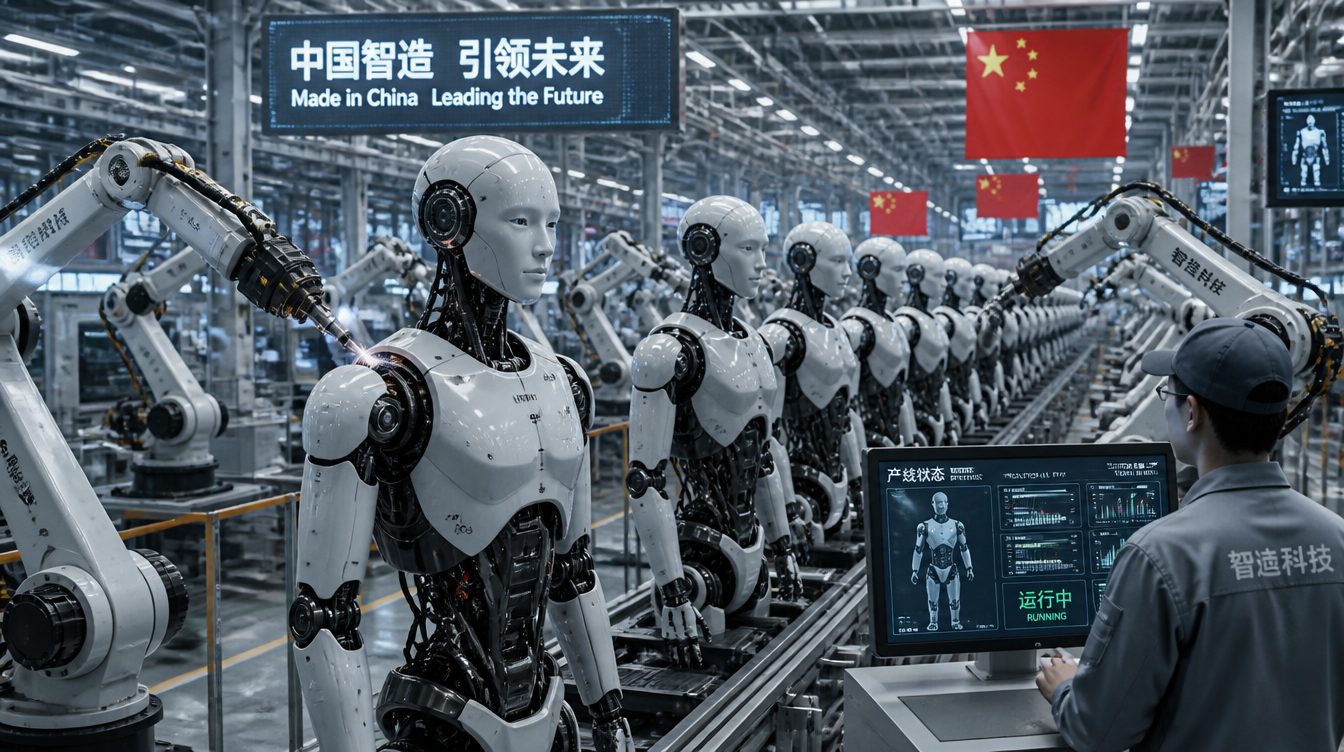
UBTECH Robotics completes one full humanoid robot every 30 minutes on its production line, according to the company's own announcement. This marks the shift from artisanal prototyping to mass manufacturing — historically the biggest bottleneck in humanoid robotics — and signals that more affordable prices and large-scale adoption could arrive sooner than expected.
UBTECH Robotics, a Chinese manufacturer listed on the Hong Kong Stock Exchange (HKEX: 9880), released the figure to the press and to investors as a milestone in industrial capacity.
What this production capacity really means
Manufacturing a humanoid robot isn't like assembling a smartphone. Each unit integrates motors, sensors, batteries, computer vision systems, and motion-control software into a body with dozens of joints.
Until recently, this process was mostly manual, slow, and expensive. Companies like Tesla (with its Optimus robot), Figure AI, and UBTECH itself had been showing off working prototypes, but industrial-scale production remained an open question.
An automated factory running at this pace indicates that UBTECH has solved a significant part of the manufacturing equation: component standardization, assembly-line automation, and series quality control. That doesn't guarantee the robot is technically superior to its competitors, but it does signal industrial maturity — the kind of progress that historically precedes falling prices and market expansion, as Goldman Sachs described in a report on the humanoid robot market.
Why this matters for business leaders outside China
The direct answer: this news matters because manufacturing at scale is the prerequisite for affordable pricing, and affordable pricing is what determines whether a technology moves from the lab onto the factory floor of ordinary businesses.
Historically, every piece of hardware that became relevant to business — computers, solar panels, electric-vehicle batteries — went through the same curve: expensive and artisanal at first, then standardized and cheap. UBTECH is signaling that humanoid robots may be entering that second phase sooner than the market expected.
For a Brazilian business owner, this doesn't mean it's time to buy a humanoid robot tomorrow. It means the planning horizon for advanced automation in physical operations — logistics, assembly lines, repetitive high-risk tasks — may be shorter than it seemed two or three years ago.
Is a humanoid robot different from traditional industrial automation?
Yes, and that difference is what makes this news relevant. Traditional industrial robots are fixed, designed for a specific task in a controlled environment — a robotic arm welding car bodies, for instance, doesn't move from its spot.
Humanoid robots are designed to operate in environments built for humans, without structural renovations to the plant. They walk, climb stairs, handle a variety of objects, and can, in theory, be reassigned from one task to another with a software update rather than a hardware change.
That flexibility is what's drawing companies like Amazon, BMW, and UBTECH itself into field trials, according to Reuters reporting on the industrial adoption of humanoid robots. A successful humanoid robot has the potential to be more versatile than a fixed automation line, requiring less re-engineering of the physical plant when the process changes.
What are the real limits of this technology today
No company should make an investment decision based solely on production-capacity announcements. A few points call for caution:
- Production capacity isn't the same as proven demand. UBTECH may be able to manufacture a robot every 30 minutes, but that doesn't reveal how many units are actually being sold and operating in real production outside of demo settings.
- Real autonomy is still limited. Most humanoid robots in operation today rely on human supervision or pre-programmed tasks, with full autonomy still under development.
- Total cost of ownership goes beyond the unit price. Maintenance, staff training, integration with existing systems, and support infrastructure are costs that don't show up in a manufacturing-capacity announcement.
How to decide whether your company should pay attention to this now
There's no single answer, but a few criteria can help structure this decision:
- Assess the nature of your physical operation. Companies with repetitive, predictable, high-volume processes — such as logistics, assembly, and sorting — stand to gain more in the short and medium term than operations with highly variable tasks.
- Monitor the sector, not just one vendor. UBTECH, Figure AI, Tesla, and other competitors are in a direct race. Tracking the sector's overall momentum is more useful than betting on a single manufacturer.
- Separate hype from real signal. Production-capacity figures are signs of industrial maturity, but signed contracts, published case studies, and third-party operational results are more reliable signs that the technology is ready for your context.
- Start with diagnosis, not purchasing. Before considering any investment in advanced automation, map out exactly where it would replace human work with a real gain in efficiency, safety, or quality — and where it would only add complexity.
What changes in companies' automation strategy from now on
The direct answer: UBTECH's announcement doesn't change any company's operations tomorrow, but it does change the timeline on which decisions about physical automation need to start being planned, especially in manufacturing, logistics, and high-volume repetitive operations.
Companies that treat this kind of news as noise tend to get caught off guard when the technology's price drops sharply — as happened with solar panels and batteries. Companies that treat it as an immediate purchase decision tend to invest too early, in technology still immature for their specific context.
The wiser path lies between the two extremes: track the development, understand where advanced automation would make sense in your own operation, and keep that knowledge ready for when the decision to invest is actually justified.
Is your operation ready for the next wave of automation?
Let's map out together where AI and physical automation would make real sense in your business — no hype, with clear priorities.
Let's talk →Frequently asked questions
Does UBTECH already sell humanoid robots to regular businesses?
Yes, UBTECH sells humanoid robots such as the Walker S to industrial clients, mainly for assembly lines and logistics. Access is still more feasible for large companies with direct contracts, but the growing production pace tends to expand supply and, over time, lower entry barriers.
Does a humanoid robot replace human workers in the factory?
Today, most humanoid robot projects handle repetitive, heavy, or risky tasks, complementing human teams rather than fully replacing them. The decision of where and how to use these robots depends on the process, available investment, and each company's operational maturity.
Is it worth a Brazilian company considering humanoid robots now?
It depends on the sector and scale. For high-volume industrial operations, tracking this technology already makes strategic sense, even if adoption isn't immediate yet. For most companies, the most productive move right now is to understand this shift and map where advanced automation could have an impact in the medium term.