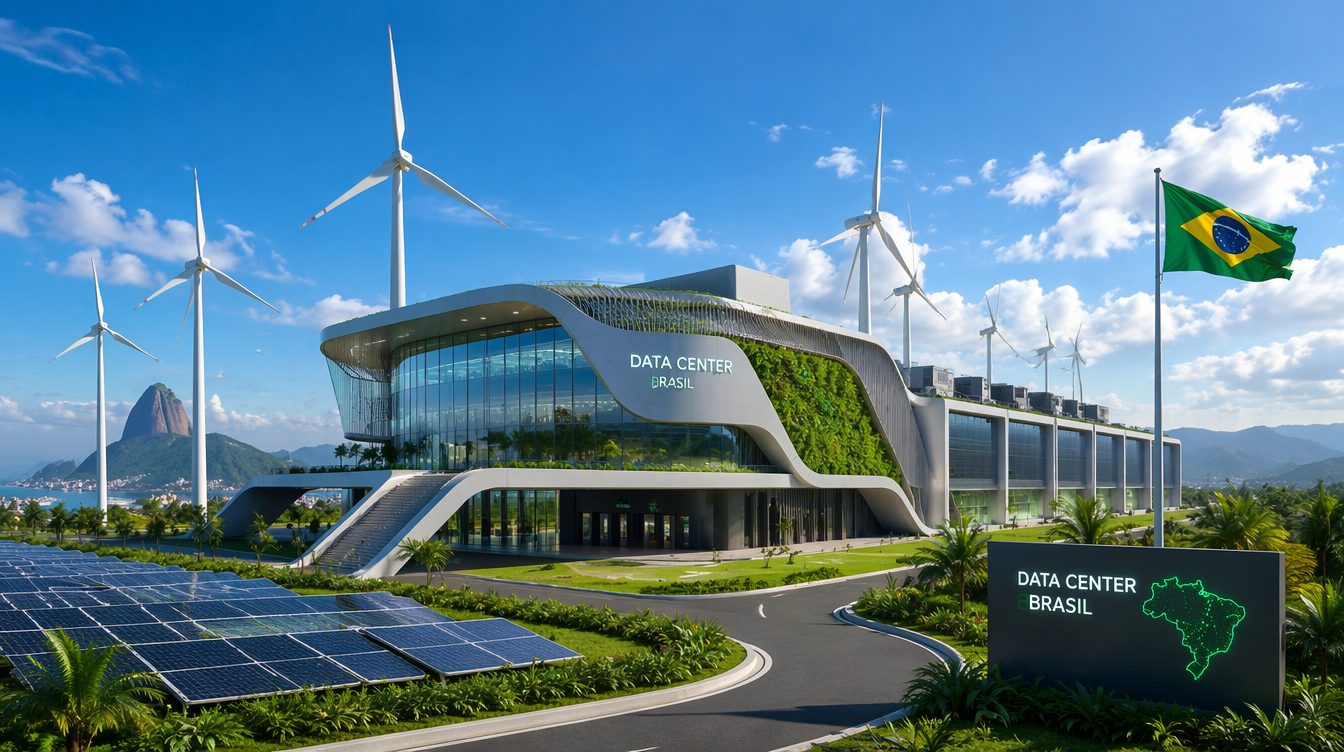
Brazil is becoming an AI infrastructure hub for two concrete reasons: the Brazilian Artificial Intelligence Plan (PBIA), with R$23 billion in planned investment through 2028 according to the Ministry of Science, Technology and Innovation, and a predominantly renewable electricity grid, which attracts global data centers.
What's driving Brazil's advance in AI infrastructure?
AI infrastructure isn't just about algorithms. It's about where you can process billions of operations per second without breaking your energy budget.
Training and running AI models at scale requires data centers with high, continuous electricity consumption. That makes energy cost and source a strategic variable, not a secondary one.
Brazil has a structural advantage here: its electricity grid is predominantly renewable, backed by hydroelectric, wind, and solar generation, according to data from the Ministry of Mines and Energy (MME). For technology companies with public sustainability targets, this eases the dilemma between expanding computing capacity and meeting environmental commitments.
Add to that a state plan — the PBIA — with a defined budget and a horizon through 2028, and the country now offers something few emerging competitors can: regulatory predictability combined with clean energy at scale.
What does the Brazilian AI Plan (PBIA) actually fund?
The PBIA isn't a single check for a single purpose. According to the plan text published by the Ministry of Science, Technology and Innovation, it's structured across axes ranging from computing infrastructure to specialized workforce training, plus applied research and sector-wide AI adoption — in areas like healthcare, agriculture, and education.
For business owners who don't work directly in technology, the practical point is this: part of this funding tends to lower the barrier for smaller companies to access computing power, qualified public data, and training programs — resources that today are expensive and scarce outside the major hubs.
This doesn't mean automatic or immediate access. State infrastructure plans tend to execute more slowly than announced. But the direction of the investment already signals where the government is betting demand will grow.
Why did global giants choose Brazil for AI?
The direct answer: abundant renewable energy, a large consumer market, and a regulatory framework that, while imperfect, has already shown it can engage in dialogue with the sector.
Companies operating data centers at global scale run this calculation coldly: where energy is more stable, cheaper long-term, and cleaner, total operating cost falls. Brazil delivers that combination with an added advantage — time-zone proximity to North America and a domestic market relevant to these companies' own AI products.
That explains why these companies' presence in the country has stopped being purely commercial (selling software, cloud, support) and now includes direct investment in physical infrastructure — servers, processing capacity, and in some cases dedicated power plants.
Is Brazil's AI startup ecosystem strong?
In terms of number of companies, yes: according to a survey by Distrito, the most recent mapping identified 975 active AI startups in the country. In terms of capital raised, the answer is harsher: only 23 of them broke the US$10 million mark, according to the same study.
This gap between the number of startups and the volume of capital reveals a natural maturity funnel, not necessarily an ecosystem failure.
Most of the startups mapped are at an early stage — validating product, seeking their first paying customers, or still testing their business model. It's expected that most of them don't yet have enough traction for multi-million-dollar rounds.
The subset of 23 companies above US$10 million raised, according to Distrito, points to where venture capital confidence is concentrated in the country: theses considered more defensible, teams with a proven track record, or products that already have significant recurring revenue.
What does this mean for leaders of companies outside the tech sector?
If you're a business owner and you're not in the business of "selling AI," the numbers above matter in a specific way: they indicate that the cost of accessing quality AI in Brazil is likely to fall in the coming years.
More locally installed infrastructure, more competition among cloud and AI providers, more domestic startups offering vertical solutions — all of this pushes prices down and quality up, especially compared to relying solely on foreign infrastructure priced in dollars.
How to take advantage of this moment before the competition does?
Companies that get ahead of this consolidation tend to capture real competitive advantage, not just innovation talk. Some practical steps:
- Map where AI already solves a concrete problem in your business — customer service, demand forecasting, internal process automation — before you look for a vendor.
- Evaluate emerging domestic vendors, not just the global giants. Some of the startups mapped by Distrito are building solutions specific to the Brazilian market, with an understanding of regulation and language that generic platforms lack.
- Follow calls for proposals and programs tied to the PBIA, especially those focused on training and access to computing power — they can lower the cost of adoption for mid-sized companies.
- Don't wait for "AI to be ready." The infrastructure is being built right now; those who test and learn early reach market maturity with an internal process already running, while competitors are still deciding where to start.
Will Brazil become a global AI hub?
It's still too early to say for certain — infrastructure takes years to mature and depends on consistent execution of the public budget and regulatory continuity. But the signs are concrete: earmarked public money, clean energy as a structural advantage, and the physical presence of global players who typically only install data centers where they see long-term return.
For anyone leading a company today, the right move isn't to wait for the dust to settle. It's to understand this landscape now, test AI applications in your own business, and choose vendors — large or small — who understand the Brazilian context as well as they understand the technical model they're selling.
Is your company ready for this moment in Brazilian AI?
Let's map out where AI can generate concrete results in your business, with the right vendors and clear priorities.
Let's talk →Frequently asked questions
What is the Brazilian Artificial Intelligence Plan (PBIA)?
It's the federal government's strategy to position Brazil in the global AI chain, with R$23 billion in planned investment through 2028, according to the Ministry of Science, Technology and Innovation. The plan covers computing infrastructure, talent development, applied research, and AI adoption in sectors like healthcare, education, and agriculture.
Why are global AI companies investing in Brazil?
The main draw is Brazil's electricity grid, which is predominantly renewable (hydroelectric, wind, and solar), according to the Ministry of Mines and Energy. AI data centers consume large volumes of energy, and operating in a country with clean, cheaper electricity lowers operating costs and helps these companies meet their sustainability goals.
Why do so few Brazilian AI startups raise large funding rounds?
According to a survey by Distrito, of the 975 AI startups mapped in the country, only 23 raised more than US$10 million. This reflects a natural maturity funnel: most are still at an early stage, with a product still being validated, and AI venture capital in Brazil remains concentrated in a few theses considered more scalable.