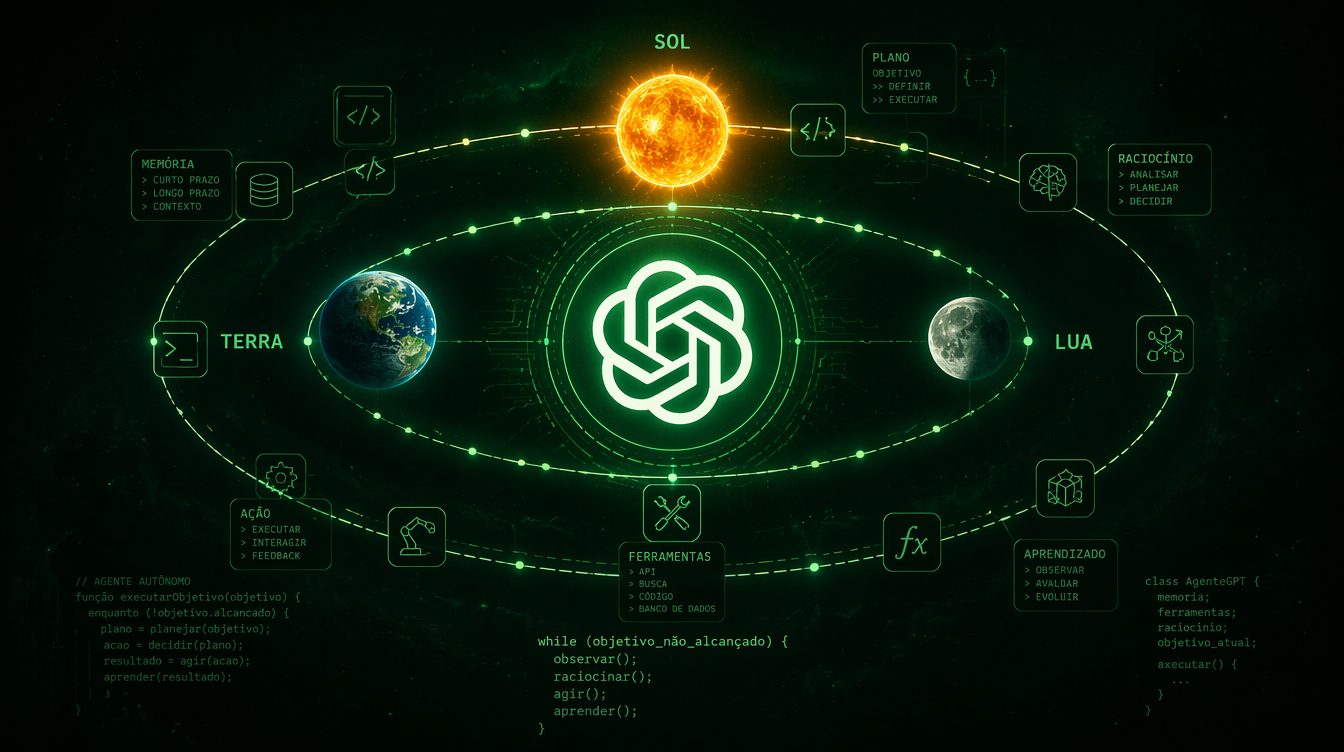
According to OpenAI's official announcement, GPT-5.6 was released to the public in three tiers: Sol (top of the line), Terra (balanced), and Luna (economy option), with a stated focus on agentic coding and cybersecurity. This tiering directly changes the cost of running AI agents in production.
For whoever decides where to invest in AI within the company, this tiering isn't just a different pricing table. It's a signal that OpenAI is recognizing something anyone already running AI in production has known for a while: not every task needs the most expensive model, and not every cheap model works for every task.
What actually changes between Sol, Terra and Luna?
All three tiers share the GPT-5.6 base, but were tuned for different usage profiles, according to the launch documentation published by OpenAI (openai.com).
- Sol: built for complex tasks — agentic coding (agents that plan and execute multiple steps on their own) and cybersecurity scenarios that require deeper reasoning. It's the model for when the cost of error is high.
- Terra: designed as the middle ground. It works well for most commercial applications that don't need top-tier capability but also can't sacrifice much quality.
- Luna: the volume tier. Built for simple, repetitive tasks, where cost per token matters more than the sophistication of the response.
In practice, this means the same company can — and probably should — use all three tiers at once, depending on the task.
How much does each GPT-5.6 tier cost?
Prices, according to the table OpenAI published at launch, are charged per million tokens, split between input (what you send) and output (what the model generates):
Tier Input Output Sol US$5 US$30 Terra US$2.50 US$15 Luna US$1 US$6The difference between Sol and Luna is five times the input cost. In applications that process large volumes of tokens — automated customer service, document triage, content generation at scale — this difference decides whether the product is profitable or not.
Why does Sol's token efficiency matter so much?
OpenAI reports, in its own launch materials, that Sol is more efficient at coding tasks — meaning it produces the same result using fewer tokens. That's different from "being cheaper per token": it's about using fewer tokens to get to the same place. Since OpenAI doesn't publicly detail the full methodology behind this gain, the exact figure should be treated as a vendor claim, not an independent benchmark — it's worth testing on your own use case before deciding.
For agentic coding — where an agent can make dozens of calls to the model to plan, execute, and fix code — this efficiency gain compounds. An agent that runs many iterations per task feels the effect far more directly than a single chat call does.
This matters for business owners because it changes the viability math: a use case that once seemed too expensive to run in production can start to make financial sense with Sol, even though it costs more per token than Terra or Luna.
How do I choose the right tier for my business?
The choice shouldn't be made on price alone, but on the total cost of the task. A practical step-by-step:
- Map your current or planned use cases. Separate what's a simple task (summarizing, classifying, answering FAQs) from what's a complex task (agents executing multiple steps, security analysis, code generation with dependencies).
- Test Luna first on the simple tasks. Measure output quality before assuming you need more computing power.
- Reserve Sol for where errors are costly. Agentic coding and cybersecurity are explicit examples from OpenAI itself — that's not a coincidence.
- Use Terra as the intermediate default for anything that doesn't clearly fit either extreme.
- Track cost per completed task, not cost per token. A more expensive model that solves it in fewer calls can end up cheaper overall.
Does this change my company's AI strategy?
If your company already uses GPT in production, the practical answer is: review your model allocation by task, don't switch everything at once. Tiering exists precisely to allow this fine-tuning — matching each task to the model best suited for it, instead of standardizing everything on the same model.
If your company doesn't yet use generative AI in a structured way, the GPT-5.6 launch is a good reason to start by mapping use cases before choosing a vendor or model. The right question isn't "which AI is the best," but "which task does my company need to solve, and which tier solves it at the lowest acceptable cost."
The takeaway for whoever leads technology decisions
AI models are increasingly segmented by use case, rather than by a single "best overall model." This demands more maturity from decision-makers: understanding the business process before choosing the tool. Companies that treat AI as a single commodity tend to either overpay or deliver too little quality — the two mistakes tiering is designed to fix.
Learn more at: https://ub5.com.br/blog/gpt-5-6-para-empresas-guia-estrategico
Which AI tier makes sense for your business?
We'll map your use cases and define where it's worth investing in capability and where it's worth saving on tokens.
Let's talk →Frequently asked questions
What's the difference between GPT-5.6 Sol, Terra and Luna?
They're three tiers of the same model with different cost and capability. Sol is the top tier, built for complex tasks like agentic coding; Terra aims for a balance between cost and performance; Luna is the cheapest option, suited for high volume and simple tasks.
How much does it cost to use GPT-5.6?
According to the pricing table published by OpenAI, rates are charged per million tokens (input/output). Sol costs US$5 for input and US$30 for output, Terra costs US$2.50 and US$15, and Luna costs US$1 and US$6. Choosing the right tier directly impacts your product's operating cost.
Is it worth migrating my product to GPT-5.6 now?
It depends on your use case. If your application involves agentic coding or cybersecurity tasks, testing Sol makes sense given the token-efficiency gains OpenAI reports. For high volumes and repetitive tasks, it's worth starting with Luna and measuring quality before scaling cost.