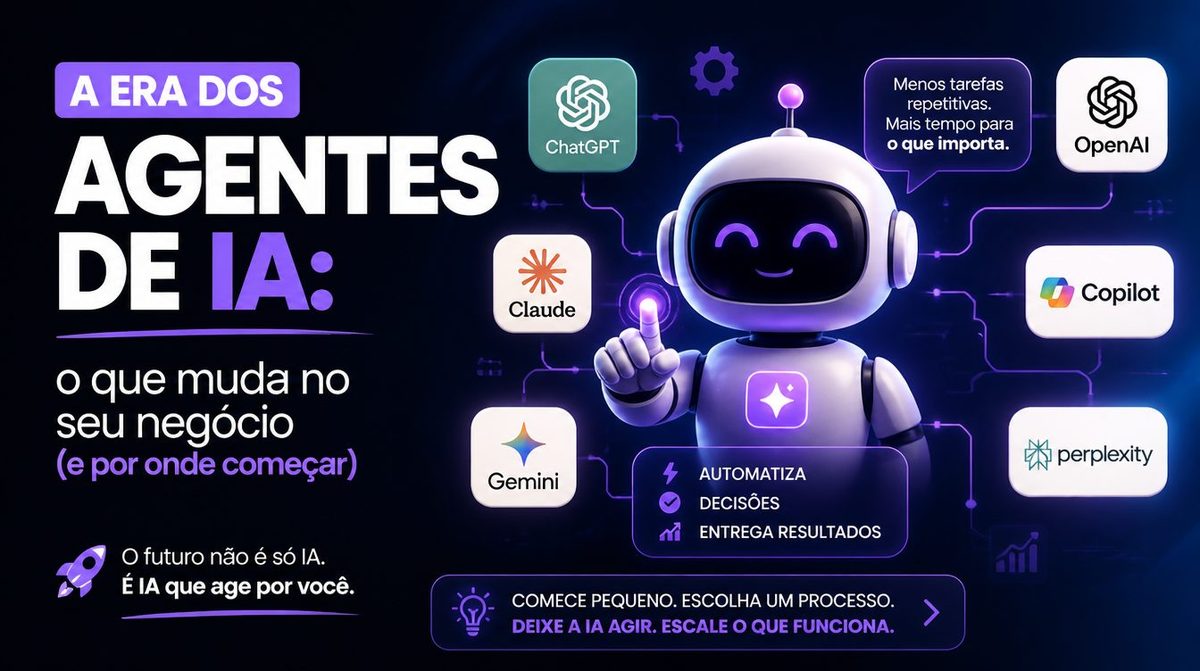
An AI agent is an autonomous system that receives a goal and executes it on its own: it uses tools, accesses systems, and makes intermediate decisions. Unlike a chatbot, which only responds when asked, an agent acts without waiting for a command at every step.
A business owner asked me last week: "But isn't an AI agent just a fancier chatbot?" I understand the confusion — but it's the kind of confusion that can get expensive. Not because the question is naive. It's a legitimate one. The problem is that the wrong answer leads a company to implement the wrong tool, for the wrong process, for the wrong reason — and then conclude that "AI doesn't work for our business."
I've worked in technology for more than 20 years. I've seen waves of automation, digital platforms, Digital Transformation with a capital D. Most of those waves promised more than they delivered in the short term — and delivered more than people expected in the long term. With AI agents, I'm seeing something different happen: the delivery is arriving before the promise has been fully understood. And anyone still waiting for "the hype to pass" might wake up behind.
What an AI agent actually is
An LLM — a language model like GPT-4 or Claude — is, at its core, a very sophisticated text-completion machine. You ask a question, it answers. You ask for a summary, it summarizes. It's passive. It waits for the next prompt to act.
An AI agent is a different category altogether. It doesn't wait. It receives a goal — "monitor contracts expiring in 60 days, notify the person responsible, and draft a renewal" — and carries it out autonomously. It uses tools. It accesses systems. It makes intermediate decisions. It checks the result. It turns to humans only when it hits an ambiguity it can't resolve on its own.
"The difference between a chatbot and an agent is the difference between a consultant who answers questions and an employee who solves problems. One you consult. The other you hire for a task."
From a technical standpoint, an AI agent's architecture involves at least four components: a language model as the central brain, a set of tools (APIs, databases, internal systems), a context memory — so it knows what it has already done — and a plan-execute-verify loop. That's exactly what makes it transformative: the loop closes without needing a human at every step.
According to Gartner, a growing and significant share of corporate digital interactions is expected to involve AI agents already within this decade. This isn't a conservative projection — it's an acceleration that's already happening in sectors that made adoption decisions two or three years ago.
What changes in your business
The most immediate change isn't technological — it's economic. Today, scaling an operation means hiring. More customers, more support staff. More data, more analysts. More processes, more coordination. The AI agent breaks that equation. You can multiply capacity without multiplying headcount at the same rate.
That doesn't mean laying people off. It means reallocating them. The best teams I know are using AI agents to eliminate mechanical work and free up humans for work that requires judgment — which is, ironically, the one type of work agents still do worse.
Here's how that plays out in specific sectors:
A high-SKU e-commerce operation faces the classic chaos: keeping competitive prices updated, responding to negative reviews, restocking inventory, generating product descriptions. An agent can monitor competitor prices in real time, propose adjustments within parameters set by the commercial team, draft personalized responses to reviews, and trigger a restock order when inventory hits the cutoff level — all without human intervention at every step. What used to take three people across different shifts is now overseen by one person with clear dashboards.
Law firms are using AI agents for initial case triage, contract analysis to flag problematic clauses, court deadline monitoring, and drafting filings from templates. The attorney remains responsible — the agent eliminates the hours of research and formatting work that consumed time without adding real legal judgment. The practical result: senior attorneys serve more clients at the same quality.
There's also a time dimension. Support that never sleeps is no longer a differentiator — it's becoming a market expectation in many segments. An agent that answers questions, qualifies leads, books meetings, and resolves support requests at 2am isn't a luxury. It's competitive infrastructure.
Where to start without burning your budget
The most common mistake I see: companies want to start with the most glamorous process, not the most problematic one. "Let's build a strategy agent." "Let's automate content creation." It starts big, with an undefined scope and inflated expectations — and three months later the project gets shelved with the conclusion that "AI still isn't mature enough."
The approach that actually works is different:
- Map the processes with the most friction. Where does your team waste time doing the same thing repeatedly? Where do human errors cost the most? Where does dependence on one specific person create bottlenecks? Those are the real candidates for AI agent automation.
- Start small and in real production. An agent that already works for most interactions in production is worth more than a theoretically perfect solution stuck in a test environment. Real learning comes from contact with real cases, not simulations.
- Measure before you scale. Define two or three clear metrics before implementing: average resolution time, error rate, hours saved. If the agent doesn't move those metrics within 60 days, something is wrong with the scope — not the technology.
- Choose tools that fit the moment. Not every case requires custom development. There are platforms on the market that let you build simple agents on a reduced budget. Save the custom build for when the requirements are specific enough to justify the investment.
The logic is the same as any good product strategy: learn cheap, scale what works.
"The right process to start with AI agents isn't the most exciting one — it's the most tedious, repetitive, and chronically unsolved one you have. That's where ROI shows up first."
Why most companies still haven't gotten it off the ground
After talking with dozens of business owners about AI over the past two years, I've identified a clear pattern. The obstacle is rarely technological. The technology exists, works, and is more accessible than ever. The obstacle is strategic — and sometimes emotional.
There are three main blockers:
- Fear of implementing it wrong. Experienced business owners have already seen technology projects fail from poor execution. The instinct toward caution is healthy. The problem is when caution turns into paralysis.
- Lack of clarity about what's possible. The AI ecosystem produces noise at an absurd pace. It's hard to tell what's hype from what's applicable to your specific context. Without clarity, the easiest decision is not deciding.
- The absence of a partner who bridges tech and business. This is the most critical one. Most AI projects fail not from a lack of technical capability, but from a lack of alignment between what the technology does and what the business needs. When the IT team implements without understanding the process, or when leadership defines the scope without understanding the technical limitations, the result is an agent nobody uses.
The gap isn't technology. It's adoption strategy. Implementing an effective AI agent requires someone who deeply understands both sides: how the technology works under the hood and which business problems it actually solves. That profile is rare — which is exactly why so many implementations never leave the PowerPoint stage.
Another factor rarely discussed: change management. An AI agent that automates a process inevitably creates resistance among the people whose jobs change. Ignoring this is a guaranteed way to make the technical project succeed and the human project fail. Adoption needs to be managed with just as much care as the architecture.
What I would do in your shoes
I wouldn't wait any longer. But I also wouldn't rush. I'd pick one process — just one — that meets these criteria: high volume, reasonably well-defined rules, measurable impact, and controlled error tolerance. I'd invest in mapping it out before writing a single line of code or signing up for a platform. I'd define success metrics before starting. And I'd choose a partner who knows how to ask the right questions before proposing solutions.
The window of competitive advantage for those who adopt well right now still exists — but it's closing. In two or three years, AI agents in operation will be as common as corporate websites were in 2010. Those who built a strong digital presence early reaped the advantage for years. Those who build a solid agent architecture now will reap the same.
The question is no longer "if." It's "how" — and with whom.
Want to implement AI in your company?
Every business has a different entry point. Let's talk about your specific context — no jargon, no product pitch, no empty promises.
Let's talk →Frequently asked questions
What's the difference between a chatbot and an AI agent?
A chatbot (or LLM) is passive: it responds when asked. An AI agent receives a goal and executes it autonomously — it uses tools, accesses systems, makes intermediate decisions, and only turns to a human when it hits an ambiguity it can't resolve on its own.
Where should a company start with AI agents without overspending?
With the most tedious, repetitive process — not the most glamorous one. Map where friction is highest, start small in real production, define 2 or 3 metrics before implementing, and only scale what works. Learn cheap, scale what delivers results.
Why haven't most companies implemented AI agents yet?
The obstacle is rarely technological. It's strategic: fear of implementing it wrong, lack of clarity about what's possible, and — most importantly — the absence of a partner who bridges technology and business. The gap is in adoption strategy, not technology.